The Problem of Molecular Organization
Here is a number worth sitting with: the smallest ribosome (in bacteria) contains roughly 55 proteins and 3 RNA molecules. When purified separately and mixed in a test tube with the right salt concentration, they spontaneously assemble into a fully functional ribosome. No instructions, no template, no machine — just the molecules themselves, finding their correct partners and positions through blind physical interaction.
The ribosome can synthesize approximately 20 amino acids per second with an error rate of about 1 in 10,000. It achieves this with mechanical components that self-assemble from scratch in minutes. No human-engineered machine operating at equivalent size scale comes remotely close to this combination of precision, speed, and self-organization.
This is the central fact that motivates the field of biomimetic self-assembly: biology routinely builds functional nanomachines through processes that require no external manipulation. Understanding and replicating these processes could unlock a fundamentally new paradigm for nanotechnology — one based on programming molecular interactions rather than carving or depositing material with external tools.
What Self-Assembly Actually Means
Self-assembly is defined as the spontaneous organization of components into ordered structures through non-covalent interactions, without external guidance at the molecular scale. The key word is spontaneous — the system moves toward the assembled state because the assembled state has lower free energy.
This thermodynamic framing is important. Self-assembly is not magic; it is the outcome of a competition between enthalpy and entropy:
Enthalpy drives assembly. Non-covalent interactions — hydrogen bonds, hydrophobic contacts, van der Waals forces, electrostatic interactions, π-π stacking — each release a small amount of energy when formed. The assembled state accumulates many such interactions simultaneously, making it enthalpically favored.
Entropy opposes assembly. Bringing multiple molecules together reduces their translational and rotational freedom. For a structure to assemble spontaneously, the enthalpy gain must outweigh this entropic cost.
The precise balance determines not just whether assembly occurs but how it occurs. Structures assembled near the enthalpy-entropy balance point are sensitive to environmental conditions — temperature, pH, ionic strength — making them responsive. This is how many biological switches work: a small environmental change tips the thermodynamic balance, triggering a dramatic structural transition.
Drag the temperature slider and watch the ball explore the landscape. At low T it rolls into the nearest energy minimum and stays — a misfolded trap. At high T, thermal noise kicks it over barriers. The sweet spot between order and chaos is where biology operates — where a polypeptide finds its correct fold in milliseconds from an astronomical number of alternatives.
Protein Folding: Self-Assembly at the Single-Molecule Level
The most fundamental example of biological self-assembly is protein folding. A newly synthesized polypeptide chain — a linear sequence of amino acids — spontaneously collapses into a precise three-dimensional structure in milliseconds. The folded state is typically stabilized by thousands of non-covalent interactions, yet it can unfold and refold reversibly.
The thermodynamics of folding are delicately balanced. The energy difference between the folded and unfolded state of a typical protein is only about 20–40 kJ/mol — comparable to just a few hydrogen bonds. Yet this small thermodynamic preference is enough to drive the population almost entirely into the single correct native structure from an astronomically large number of possible conformations.
Critically, the information that specifies the structure is encoded entirely in the primary sequence. Christian Anfinsen's classic experiments in the 1960s demonstrated this: denatured ribonuclease A, completely unfolded and randomly scrambled, would spontaneously refold into the fully active native structure when the denaturant was removed. The sequence is the blueprint; physics does the building.
This has a profound implication: if we can design amino acid sequences that fold into specified shapes, we have a general method for creating molecular-scale objects of arbitrary complexity. This is exactly what the field of computational protein design has accomplished — proteins that fold into predetermined shapes, perform enzymatic reactions, self-assemble into cages and rings and filaments, and respond to specific molecular inputs.
Hierarchical Assembly: From Molecules to Materials
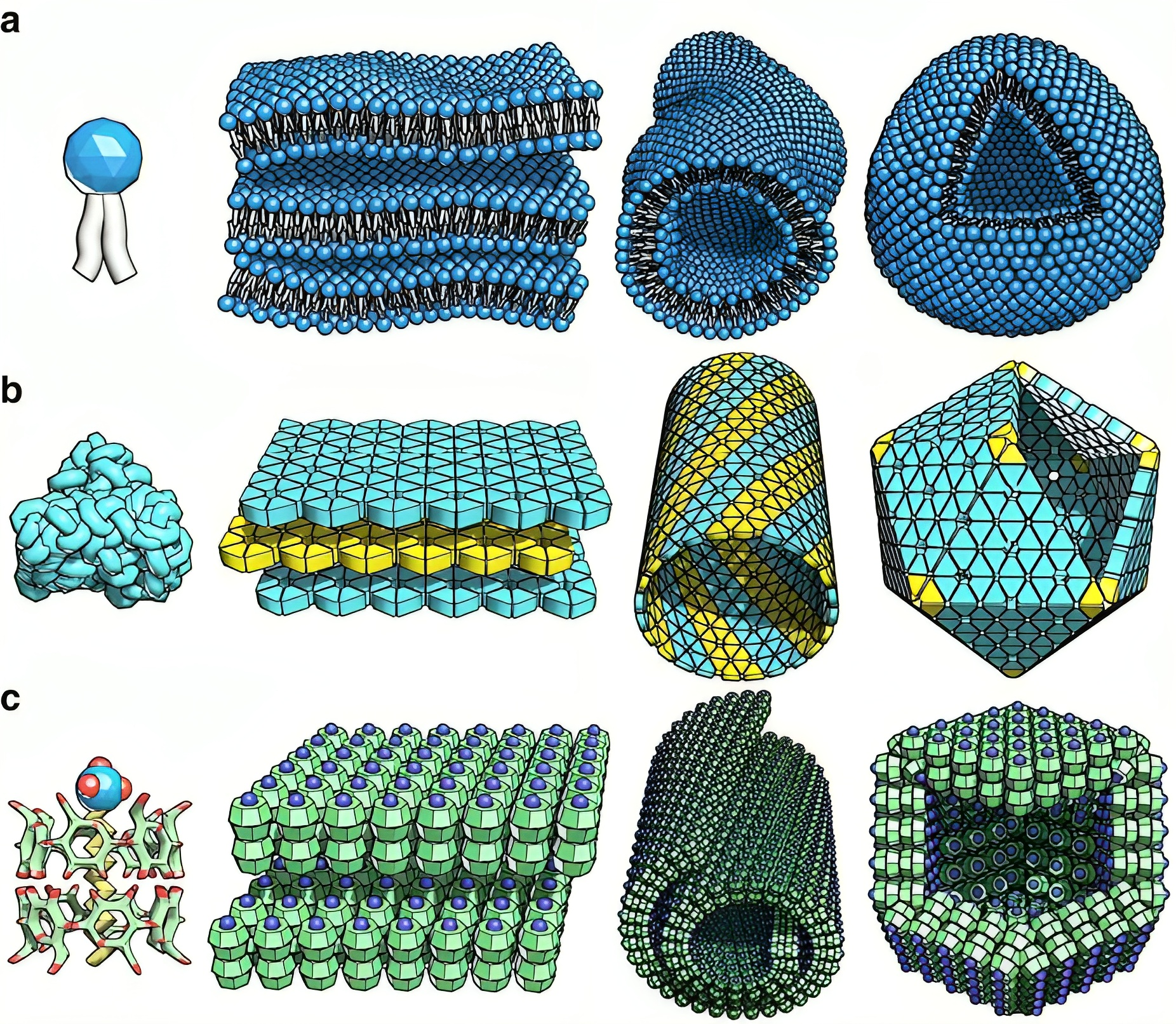
Biology does not stop at the single-protein level. Proteins that have folded into their individual shapes often assemble with other proteins into larger complexes, and those complexes into still larger structures. This hierarchical assembly — each level of structure defining the interface geometry for the next — is how biology builds things of macroscopic size from molecular components.
Viral capsids are a spectacular example. A typical icosahedral virus consists of 60 (or multiples of 60) identical protein subunits that assemble spontaneously around a nucleic acid cargo into a precisely symmetric shell. The individual capsid protein, when produced in E. coli, will assemble into capsid-like particles even in the absence of nucleic acid. The geometric information — how to build an icosahedron from 60 identical asymmetric units — is encoded in the shape of the protein surface.
Collagen self-assembles from three polypeptide chains into a triple helix, and triple helices pack side-by-side into fibrils, and fibrils assemble with accessory proteins into fibers — a hierarchy of assembly that produces one of the strongest biological materials, achieving tensile strengths that rival steel on a mass basis.
Actin and tubulin assemble into filaments and microtubules that form the cytoskeleton — a dynamic, mechanically active scaffolding inside every eukaryotic cell. Microtubules can grow by adding tubulin dimers to their ends or shrink by losing them, and this dynamic instability is exploited by the cell to probe space, capture chromosomes, and remodel the cytoskeleton in response to signals.
What unites these examples is that the assembled architecture is not directly encoded anywhere. Only the interaction rules between components are specified — and the global structure emerges as a consequence.
Press Start to begin assembly. Adjust organization force and temperature. At the right balance, every particle finds its lattice site through local interactions alone — the same logic that builds ribosomes, viral capsids, and collagen fibers.
DNA Nanotechnology: Programming Self-Assembly
In 1982, Nadrian Seeman had a simple but transformative insight: Watson-Crick base pairing is a predictable, programmable molecular interaction. If you design sequences carefully, you can direct DNA strands to assemble into any shape you specify.
The early work produced branched DNA junctions and simple two-dimensional lattices. Then, in 2006, Paul Rothemund published the technique of DNA origami: using a long single-stranded DNA scaffold (typically the circular genome of a bacteriophage, ~7 kilobases) and hundreds of short staple strands that bind the scaffold at two distant positions simultaneously, forcing it to fold into a designed shape. The staple sequences collectively specify the entire fold. The result: a two-dimensional shape, typically ~100 nm in size, with about 6 nm resolution, that assembles with near-perfect yield by simply mixing the components and annealing.
The power of DNA origami is its modularity. Want a rectangular tile? Specify one set of staple sequences. A triangle? Another. Extensions of the technique produce three-dimensional objects — boxes that open and close, barrels with pluggable ends, polyhedral cages — and can incorporate protein-binding sites, aptamers, and small-molecule attachments as functional groups.
More recently, DNA bricks and similar methods allow truly modular construction: short oligonucleotide units, each specifying a precise connectivity, that assemble into three-dimensional structures with arbitrary shapes. The theoretical design space is enormous: using a library of 32 distinct brick types, structures of up to ~1,000 nm in each dimension can in principle be constructed.
Protein Cages and Engineered Self-Assembly
Taking inspiration from viral capsids, researchers have designed proteins that self-assemble into hollow, symmetric cages with interior volumes capable of encapsulating cargo — drugs, imaging agents, nucleic acids, or enzymatic assemblies.
Ferritin, a natural iron-storage protein that forms a 24-subunit cage, has been extensively engineered for cargo delivery. Designed two-component cages use two distinct proteins, each forming oligomeric building blocks, that self-assemble at a defined ratio into cages that only form when both components are present — giving precise control over assembly and allowing loading of cargo during assembly.
The most ambitious designs use symmetric docking algorithms to identify protein-protein interfaces that, when engineered onto designed protein scaffolds, direct assembly into exact target geometries — tetrahedral, octahedral, icosahedral. These computationally designed protein nanostructures achieve the precision of viral capsids while being tunable for new functions.
Self-Assembly Beyond Biology: Colloids and Block Copolymers
The self-assembly principle extends beyond molecules to larger length scales.
Colloidal particles — typically 10 nm to 10 μm — can be designed to self-assemble through engineered interactions including DNA-mediated specificity, shape-selective packing, and depletion forces. By controlling particle shape (spheres, cubes, octahedra, tetrahedra) and surface chemistry, researchers have assembled colloidal crystals with photonic bandgaps, metamaterial properties, and complex hierarchical architectures.
Block copolymers — polymers containing two or more chemically distinct blocks — phase-separate at the nanoscale to form periodic domains whose geometry (lamellae, cylinders, spheres, gyroids) is determined by the volume fraction of the blocks. The natural periodicity is in the range of 5–100 nm, filling a length scale that is difficult to access by either top-down lithography or molecular self-assembly. Block copolymer lithography is now used industrially in semiconductor manufacturing to create features below the resolution limit of conventional optical lithography.
The Lesson for Technology
The key lessons from biological self-assembly are not individual techniques but general design principles:
Information is local, structure is global. Encode interaction rules in molecular surfaces; let physics compute the global architecture. This is fundamentally different from top-down manufacturing, where every part must be machined separately.
Error correction is thermodynamic. In self-assembly, incorrectly joined components are thermodynamically disfavored and tend to dissociate. The system naturally proofreads itself. This is why biological self-assembly achieves such high fidelity without active error-correction machinery.
Hierarchy multiplies complexity. Each level of self-assembly can define the interfaces for the next, allowing simple local rules to generate arbitrarily complex hierarchical architectures.
Dynamics matter. The most interesting biological assemblies are not static — they grow, shrink, switch conformations, and respond to signals. Engineering dynamic responsiveness into synthetic self-assembling systems is an active frontier with enormous potential.
The gap between current synthetic self-assembly and biological examples like the ribosome remains vast. But the trajectory of the field — from simple DNA tiles in the 1990s to room-temperature, near-quantitative assembly of gigadalton protein structures in the 2020s — suggests it is a gap that will close.